Tutorial: E-E-A-T & Trust Signals
Core Idea: AI is a skepticism machine. Unless you prove you are an expert, you are just noise on the internet.
In AI-generated answers, you often see "According to Mayo Clinic..." or "Wikipedia notes...". Why them? Because they possess extremely high Trustworthiness.
1. What is E-E-A-T?
This is the core concept of Google's Search Quality Rater Guidelines and a key filter for all LLM training data.
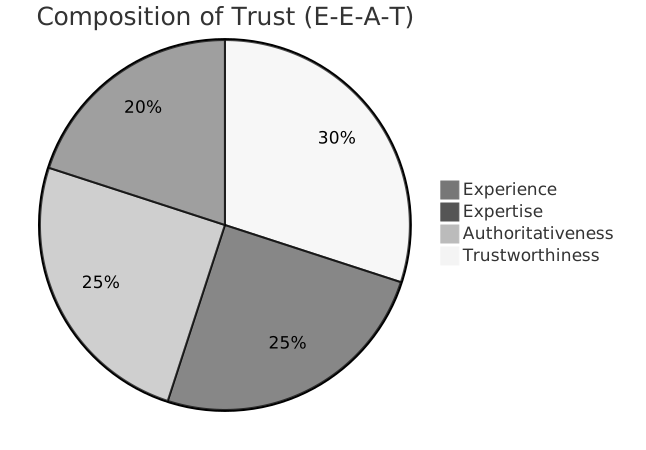 pie title Composition of Trust (E-E-A-T)
"Experience" : 20
"Expertise" : 25
"Authoritativeness" : 25
"Trustworthiness" : 30
pie title Composition of Trust (E-E-A-T)
"Experience" : 20
"Expertise" : 25
"Authoritativeness" : 25
"Trustworthiness" : 30
- Experience: Do you have first-hand experience? (e.g., "After using for 3 months, I found...")
- Expertise: Do you have credentials? (Degrees, Certs, Years in field)
- Authoritativeness: Do others cite you? (Backlinks, Press Mentions)
- Trustworthiness: Is the site secure? transparent?
2. Importance of Author Pages
Anonymous content fails in the GEO era. AI needs to know "who is speaking". Create detailed Profile Pages for every author.
Date: 2024-05-01
Bio: 10 years in NLP dev, former engineer at Big Tech. Author of "LLM Principles".
LinkedIn | GitHub | Twitter
3. Citation Transparency
Don't be afraid to link out. Linking to high-quality sources (.edu, .gov, Wikipedia) tells AI: "I did my homework, my info is verifiable."
GEO Best Practice:
- At least 2-3 authoritative external links per article.
- Use superscripts `[1]` to mark sources when presenting data.
4. Site Security & Policy
Sounds basic, but these pages are "Trust Pillars":
- About Us: Clearly state mission and team.
- Contact: Real address or email.
- Privacy Policy: Legal compliance.
- HTTPS: Must have SSL.
5. Avoiding Bias
AI dislikes extreme views. When reviewing products or discussing controversial topics, present both sides (Pros & Cons), use neutral language, not emotional venting.
Summary
Trust is not built in a day. By consistently outputting high-quality content, showing real identities, and citing authority, you accumulate "Credit Score" in AI's knowledge network.
Series Complete 馃帀
Congratulations! You have mastered the core methodology of GEO. Now, go optimize your website!